
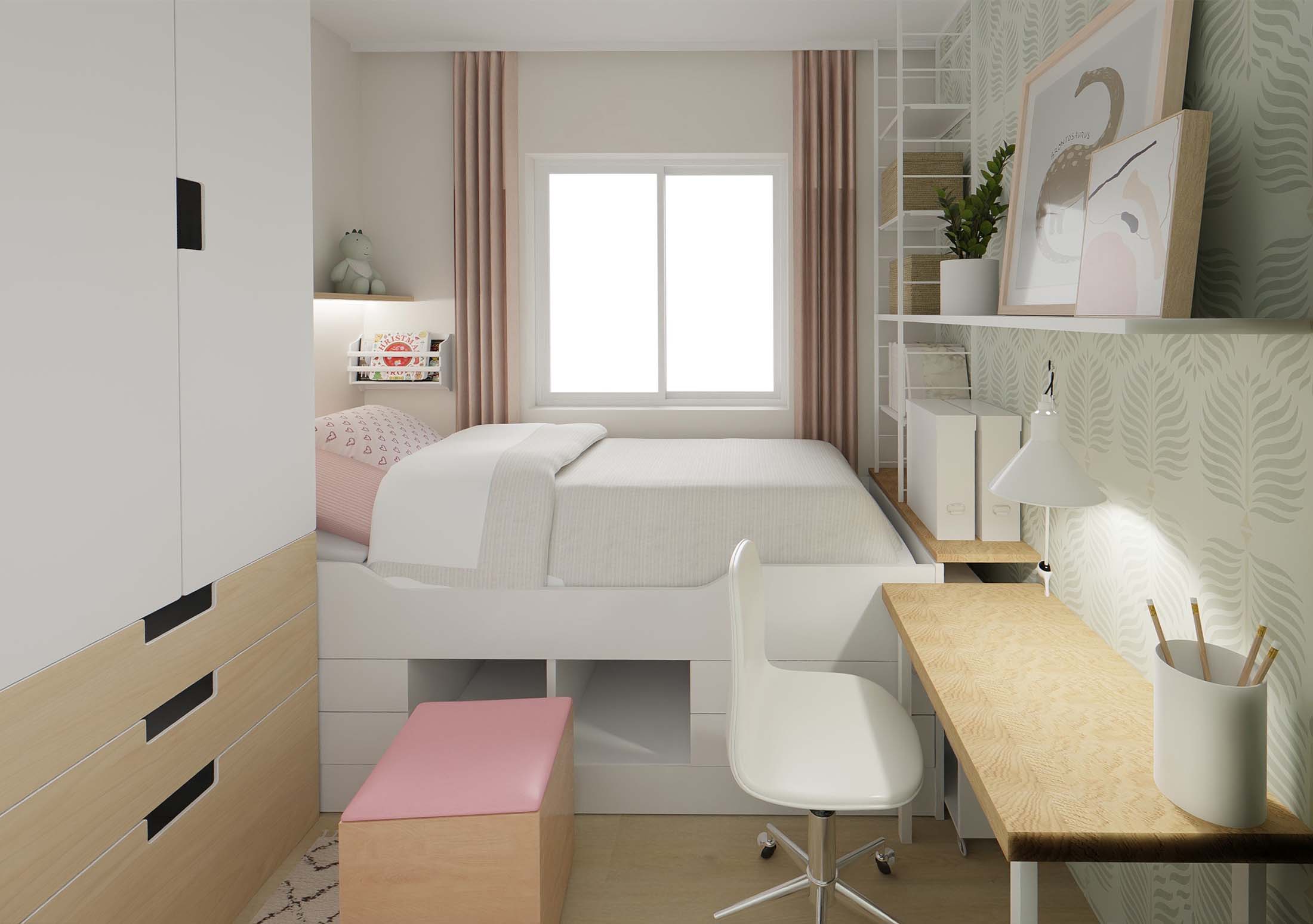
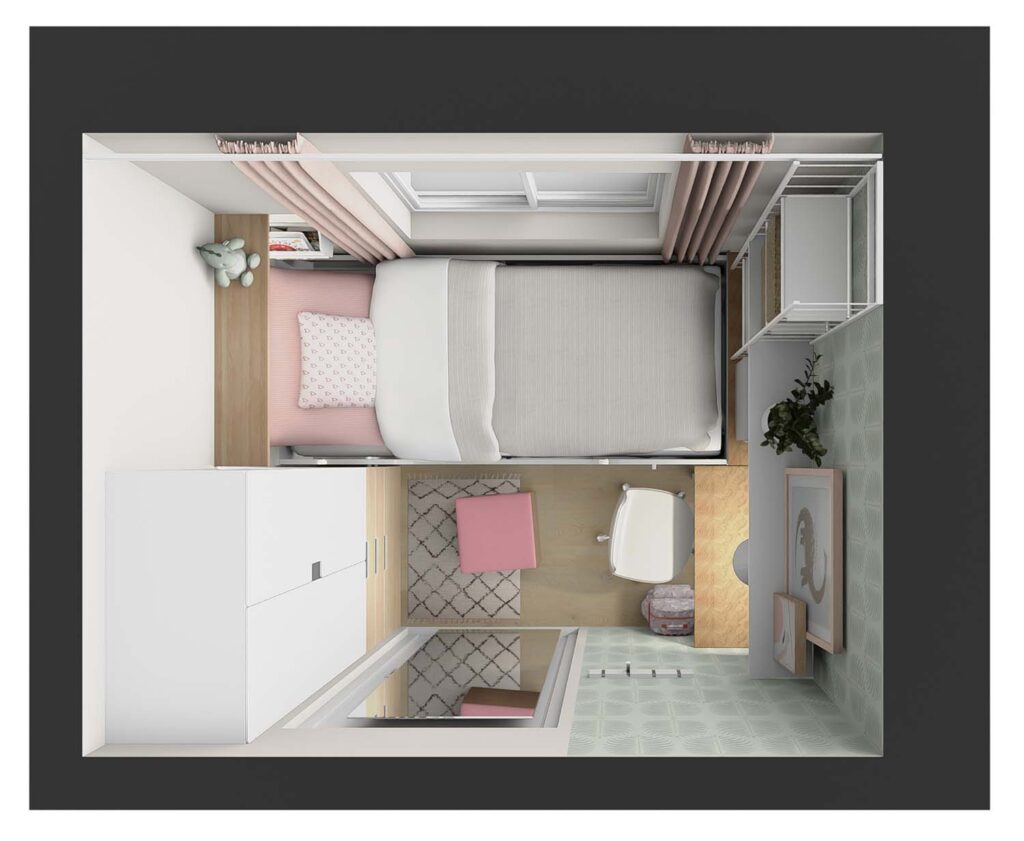
You’re looking at a floor plan measuring less than 4 square meters, and you know: This is where a real kid’s room is going to be created. That’s exactly the challenge a mother came to me with. A narrow room measuring 2.24 x 1.75 m, with one window and one sliding door. Her question: Can this even work? Yes, it can. But only with a clear plan.
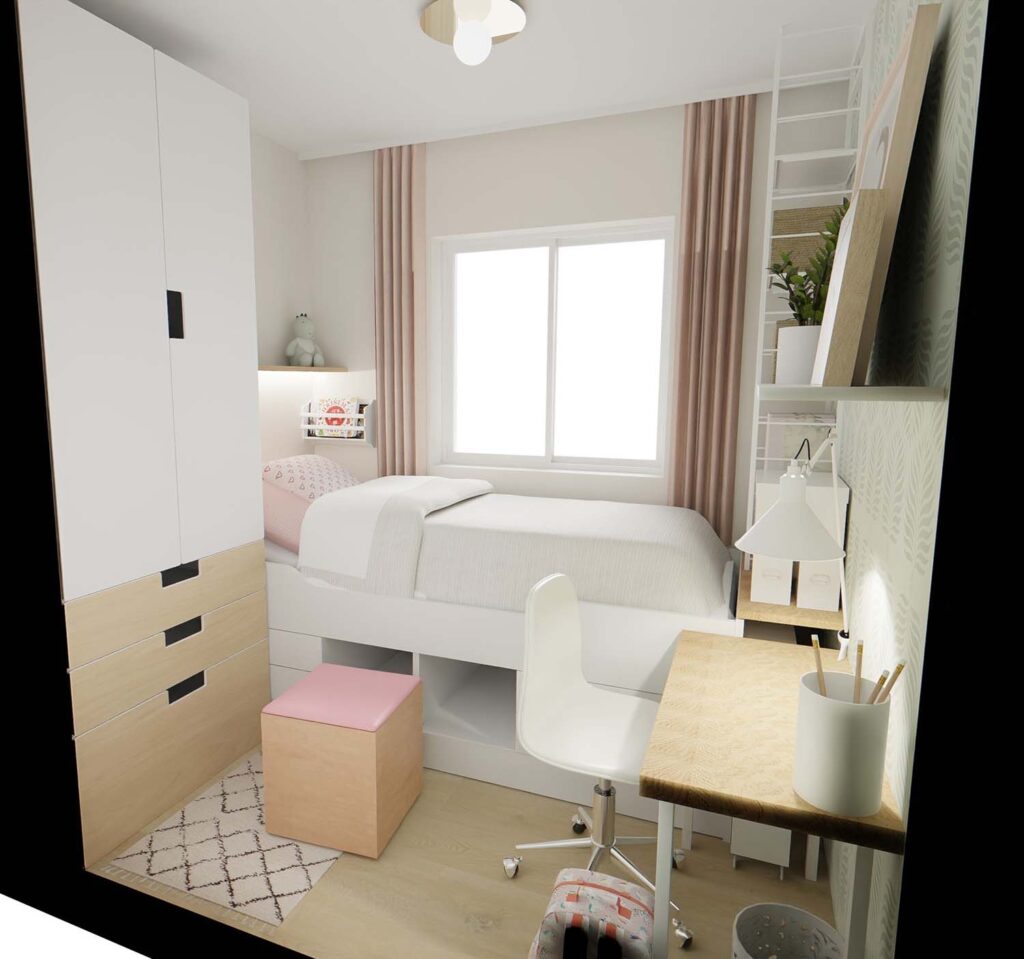
For her and her daughter, I developed a design concept that makes the most of every centimeter: the bed in just the right spot, a wardrobe with minimal depth, and a desk designed with the future in mind. No furniture Tetris—just a well-thought-out solution that feels calm yet still accommodates everything a child needs. Because furnishing a 4 m² kid’s room only works with careful planning.
1. The Floor Plan: Why Placement Is Everything
With just under 4 m², there’s no room for chance. Every decision directly affects freedom of movement and the sense of space. The good news: The room has a clean layout and features a sliding door. That alone saves valuable space, since no door leaf protrudes into the room.
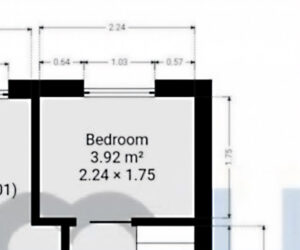
The key factors are:
- Window Position
- Possible radiators under the window
- Location of the light switch
- Wall facing the exterior facade
- Ceiling height
It’s not worth moving walls here because a staircase starts right outside the room. The gain of just a few square centimeters would be disproportionate to the effort involved. So instead of making structural changes, we need to think functionally: What really needs to be in this room, and what could possibly be moved elsewhere?
2. The Bed by the Window: The Most Important Element
The bed is the largest piece of furniture and defines the entire layout of the room. Given this floor plan and the desire for a bed that is large enough to be used well into adolescence, the only possible placement is in front of the window.
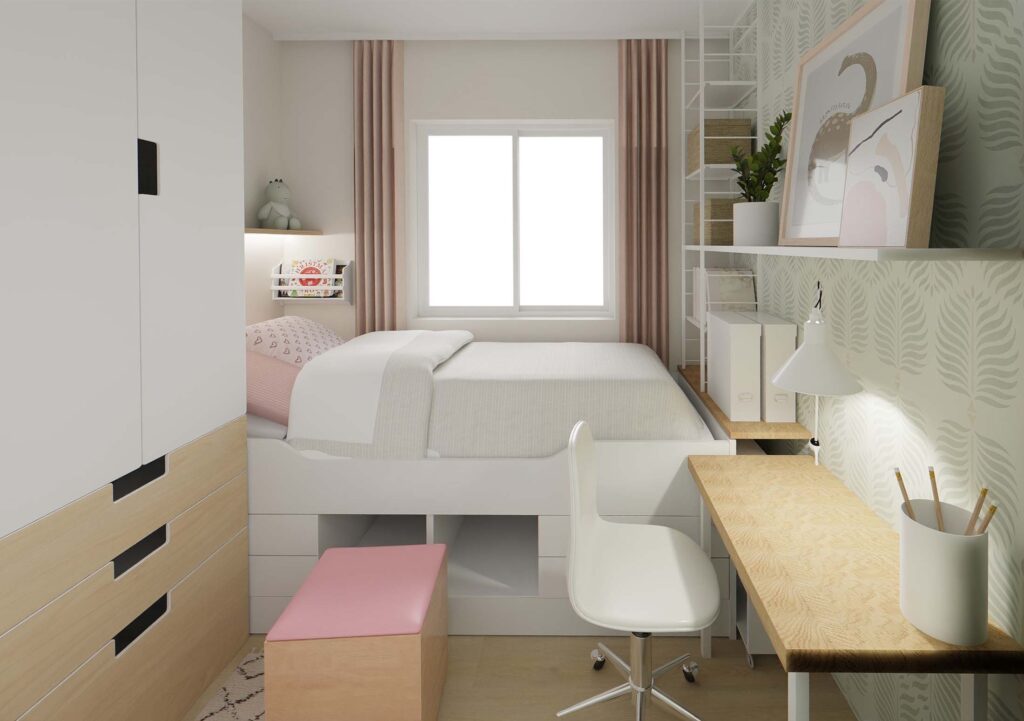
Important considerations when placing the bed:
- Do not place the headboard directly against the exterior wall, as it is cooler there
- Natural light streams in from the side, creating a calm atmosphere
- The curtain can drape softly behind the bed
A bed with storage space is worth its weight in gold here. Options:
- Bed with built-in drawers
- Platform structure with pull-out sections
- A DIY solution made from shelving units (e.g., IKEA Kallax)
Please note: If the closet or desk is placed directly next to the bed, drawers in that corner of the bed may not open. This means that, depending on the room’s proportions, a bed with open shelving or a bed with a hydraulic lift mechanism might make more sense than one with drawers. Here are a few different examples (advertisement—clicking on the respective image will take you to Amazon*):


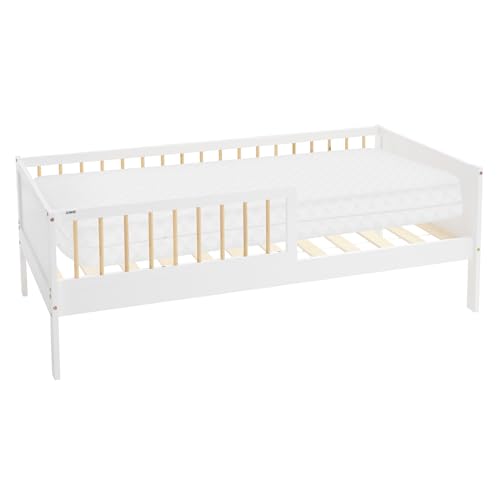

A bed with higher storage has the advantage that, first, you can store more items, and second, you can still see out the window even when sitting on the bed. But of course, it also takes up a lot of space, which is why—depending on your taste—a simple, lower bed might be the right solution. In that case, I recommend a bed with legs so that the space underneath can still be used for storage boxes.
If there is a radiator on the wall under the window, the bed must be placed at a slight distance from it. Alternatively, a loft bed is a good option, as the sleeping area is positioned higher than the radiator and the storage space underneath the bed is designed to leave enough clearance for air to circulate.
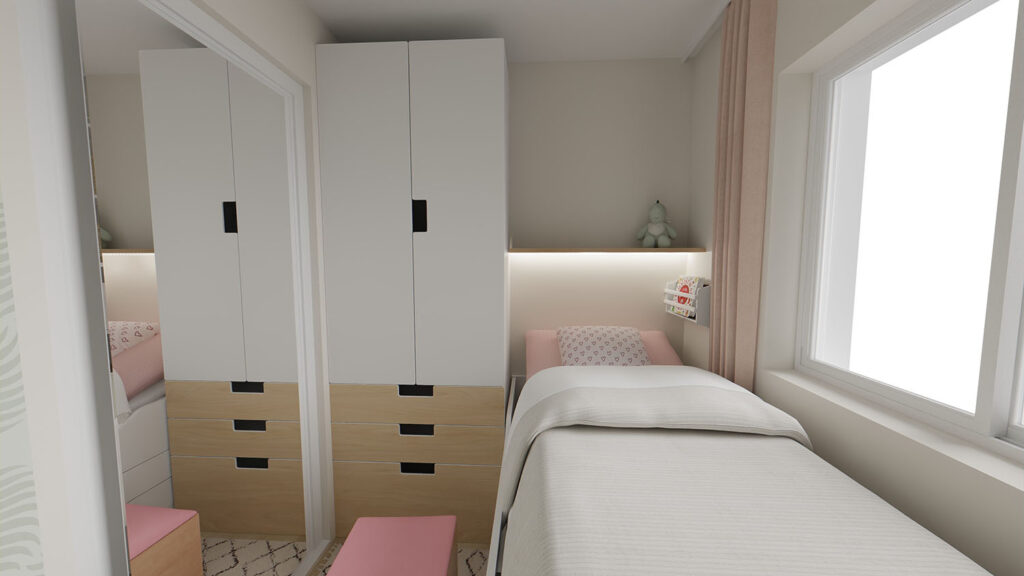
A shelf with a warm-light LED strip can be installed above the bed to serve as a reading light. If additional storage space is needed closer to the bed, a flat shelf can also be mounted on the side.
In front of the bed, a small stool with storage space can—if necessary—serve as both a step stool and a seat.
3. Mirror on the sliding door: A sense of more space through reflection
The sliding door is a big plus. Its inner surface provides the perfect space for a mirror.
Options:
- full-length mirror
- custom-made mirror film
- adhesive mirror panels
The effect is enormous:
- Daylight is reflected
- The room appears twice as deep
- A functional full-length mirror solution is created
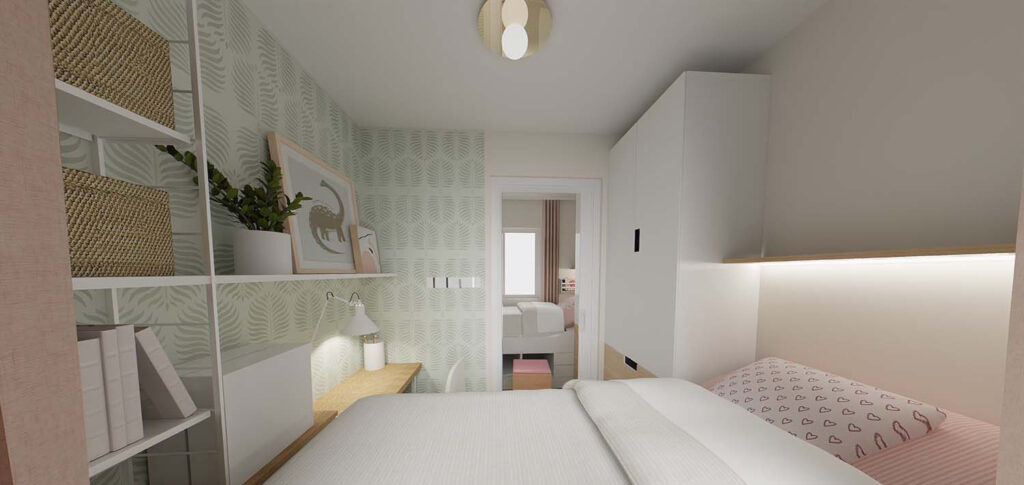
Precisely because the mirror faces the window, it noticeably increases the brightness. In a tiny kid’s room measuring just 4 m², this trick is particularly effective.
4. The 42-cm Cabinet: Slim but Functional
In a 4 m² space, every centimeter of depth counts. A wardrobe about 42 cm deep is a realistic option here. There are two practical options:
- A closed closet in which clothes are hung parallel to the back wall (e.g., IKEA SMÅSTAD / PLATSA).
- An open module in which clothes can hang at a 90-degree angle to the wall, as usual
A closed closet looks more uncluttered, but at the same time more substantial than an open closet. It also keeps clothes from gathering dust. Of course, an open closet takes up less space.
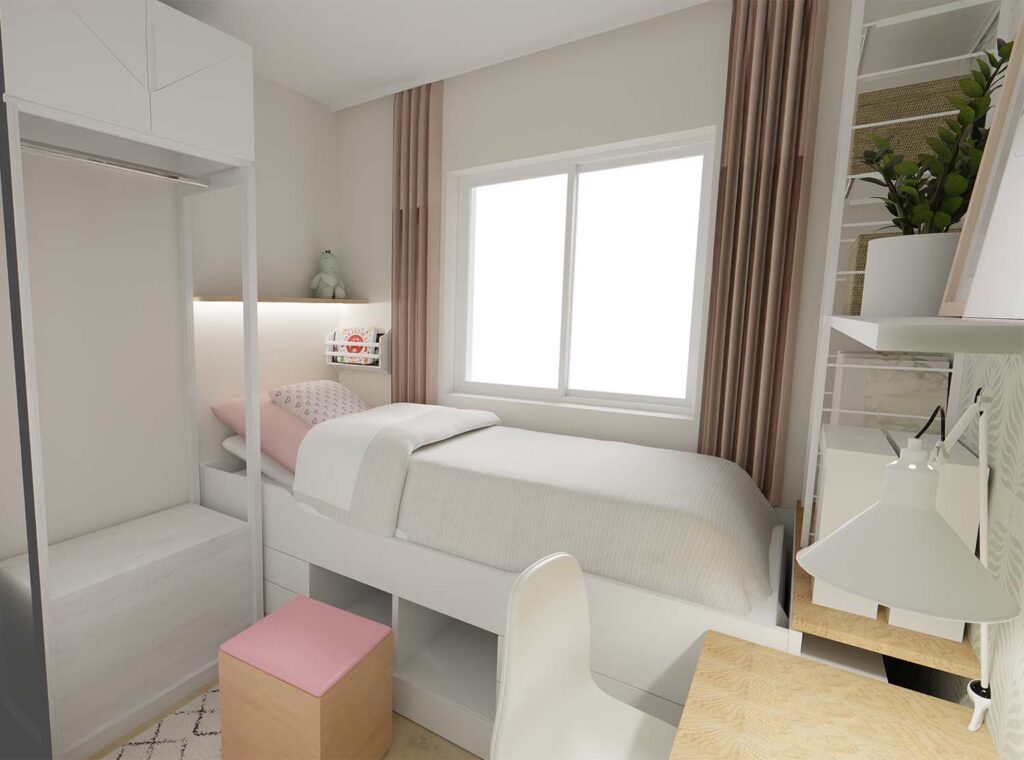
Be sure to keep the following in mind:
- Location of the light switch: It must remain accessible
- The cabinet should be no deeper than necessary so that it does not cover the door. That is why, in this specific example, a depth of 42 cm is recommended.
- Choose a design that reaches as high as possible: A floor-to-ceiling cabinet creates a more serene look than several individual pieces.
5. The Desk: Flexible and Adaptable as Your Child Grows
Nowadays, a kid’s room is often also a place for learning. Even if the desk is initially used only for drawing, it needs to be deep enough.
Placed on the right-hand wall, the result is:
- enough distance from the door
- Space for a future monitor
- distinct functional zone
- open space in the center
The following are ideal:
- slender, ideally height-adjustable table legs
- or a height-adjustable desk
When space is extremely limited, a foldable option can be a good choice. However, a fixed solution is quieter and more stable in the long run.
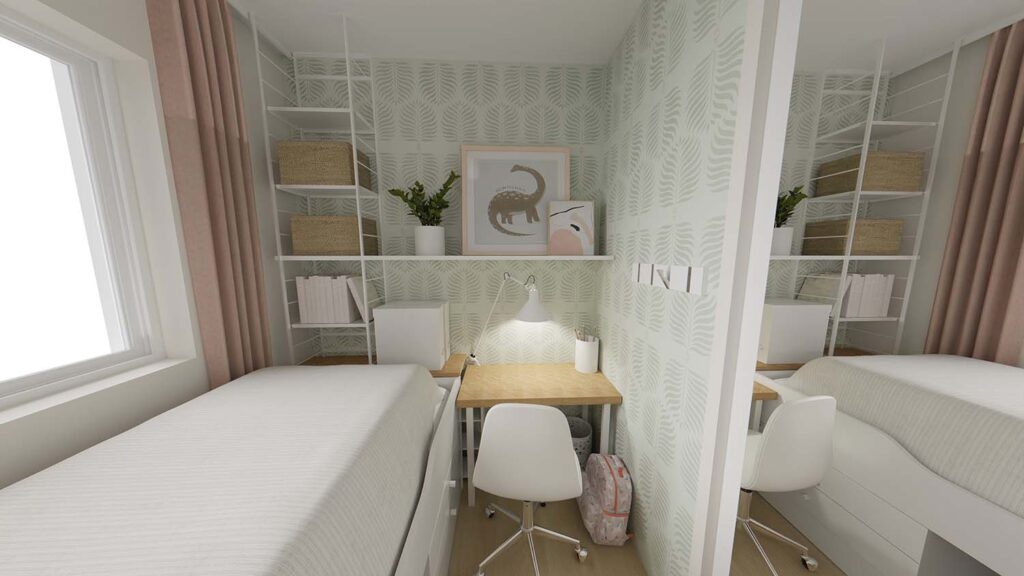
6. Make use of wall space: Shelves instead of floor furniture
Floor space is a luxury. That’s why storage solutions belong on the wall.
Good options above the desk include:
- sleek metal shelves
- open shelves
- enclosed boxes
- Combination of book and toy compartments
A continuous shelf above the desk visually connects the wall and creates a sense of horizontal calm.
Important: Don’t overcrowd the space. In such small rooms, every additional object has a greater impact.
7. Curtains hanging from the ceiling: Less visual clutter
A traditional curtain rod takes up visual space. A ceiling-mounted track is a better option.
Advantages:
- no visible mounts
- smooth transition between the wall and the window
- The room appears taller
- The fabric drapes evenly
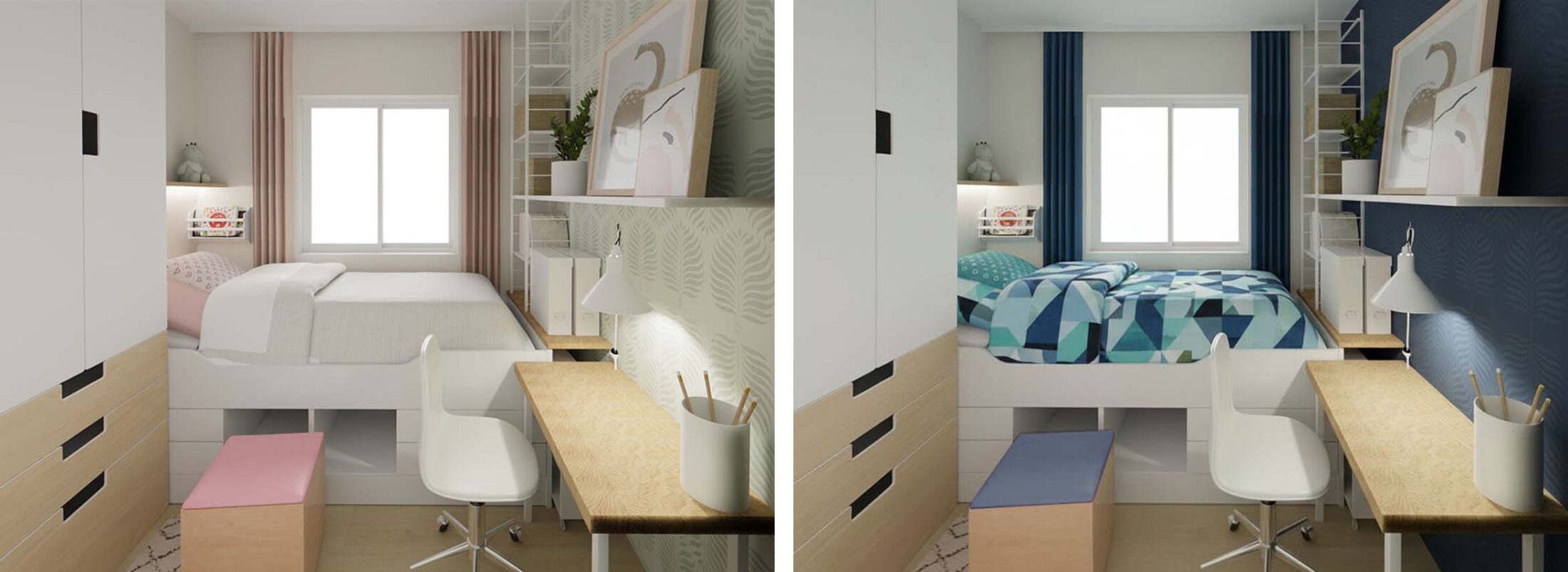
8. Color and Material Concept: Lightness Instead of Clutter
In small rooms, it’s not about painting everything a light color. What matters most is a cohesive design concept.
I would keep the furniture in more neutral colors; that way, it creates a calm atmosphere, and secondly, it won’t need to be replaced if your taste changes. Good options include:
- Warm wood tones for the table and accents
- A calm white for the bed, closet, and shelf
I also recommend using storage bins for toys and other items in neutral colors or made of natural materials, so as not to create more visual clutter than necessary in such a small space. After all, the toys themselves are often colorful enough.
However, you can also use paint on the walls: For example, the walls behind the desk and to the right of it can be painted in your favorite color. Alternatively, a subtly patterned wallpaper can add character to the room. I would, however, paint the other walls in this small room a lighter color: a very subtle cream tone radiates more warmth than a cool white. I would actually leave the ceiling white, though: it appears higher when it’s lighter than the rest of the room.
The curtains and bedding can also use bolder colors, if desired. The most important thing is repetition: When the same materials and colors are repeated throughout the room, it gives the space a neat and thoughtfully designed look.
9. Move Storage Elsewhere: Free Up Space in the Tiny Kid’s Room
The best way to furnish a 4 m² kid’s room is to declutter the space. Not everything needs to be in the room. Clothes, seasonal items, or things you rarely use can be stored outside the room.
Possible solutions outside the room:
- floor-to-ceiling closet in the hallway
- Tall cabinet in the master bedroom
- Labeled boxes in a shared storage area
- Storage bench in the entryway
This way, only the items used on a daily basis remain in the kid’s room. This reduces visual clutter and creates breathing room.
Conclusion: It works if you plan carefully.
4 m² isn’t much. You can’t hide anything, sugarcoat anything, or somehow add anything later. That’s exactly why the concept had to be right from the start.
A bed by the window, a bed with built-in storage, a slim wardrobe with a reduced depth, a work area with a desk, and a mirror on the sliding door. Every decision was made for a reason. And that’s exactly why the room doesn’t feel cluttered today—it feels harmonious.
Are you looking for more decorating tips for small kid’s rooms? You’ll find them in our ” Small Kid’s Rooms” category.
Disclaimer: The images in this article are design concepts created using interior design software.